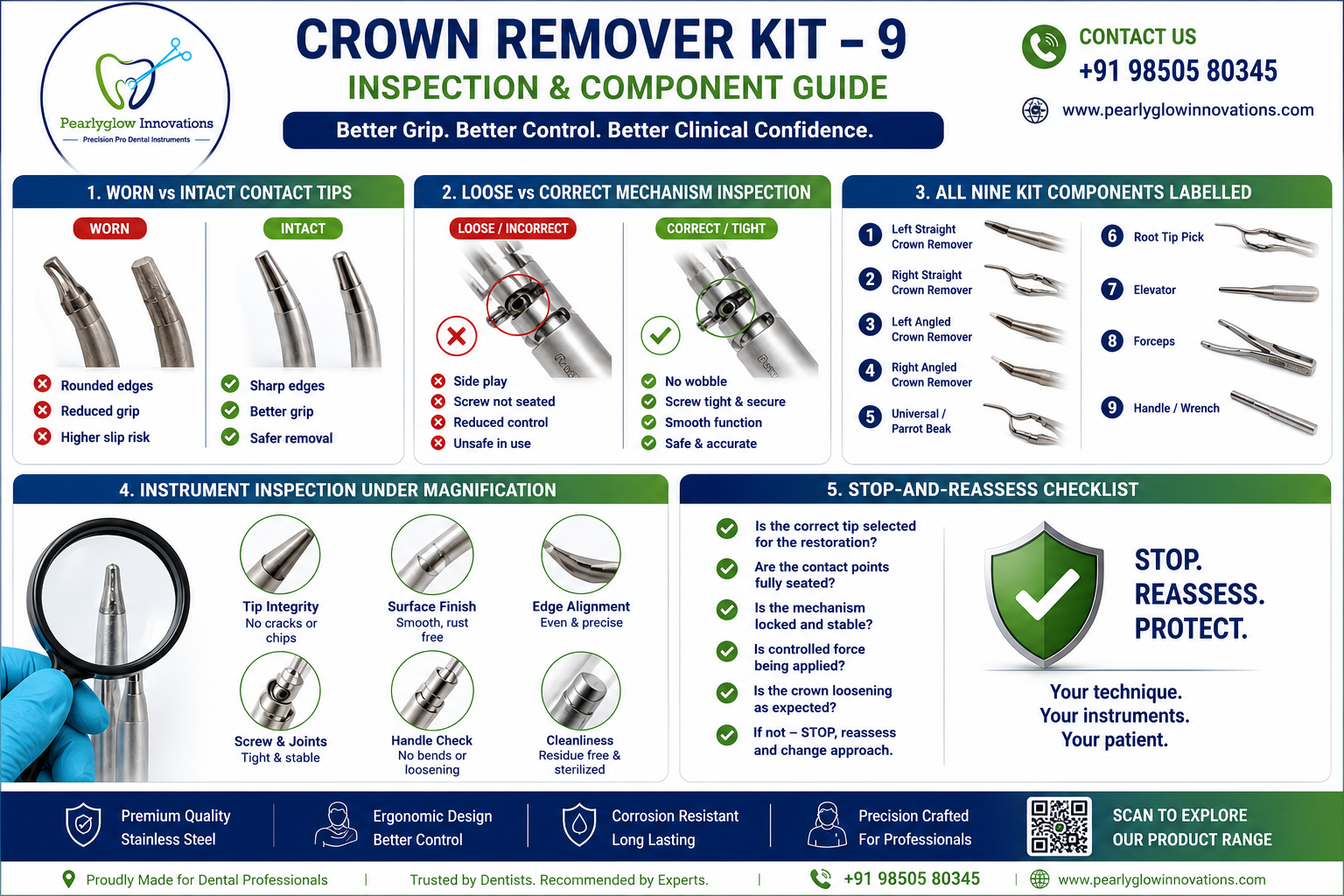
Why Crown-Removal Instruments Slip or Lose Control
Quick Answer
A crown-removal instrument may slip or feel unreliable because the selected method does not match the restoration, the purchase point is inadequate, the contact tip is worn or misaligned, the instrument mechanism is loose, the field is contaminated or the operator is applying force outside the instrument’s intended design. Slipping should not be corrected simply by increasing force. The restoration, instrument and method should be reassessed.
Common Instrument-Related Causes
Finding | Possible instrument factor | Recommended action |
|---|---|---|
Tip will not maintain contact | Worn, bent or unsuitable contact surface | Stop and inspect the selected kit component |
Mechanism feels loose | Joint, spring, lock or sliding component wear | Remove for assessment |
Instrument angle feels unstable | Wrong tip or poor access for the selected method | Reassess method and instrument choice |
Repeated repositioning | Purchase point or restoration shape does not suit the device | Consider an alternative clinically appropriate approach |
Unexpected movement | Contamination, misalignment or excessive force | Stop, clean/inspect and reassess |
Why the Clinical Situation Matters
Reviews of failed crown and bridge removal show that available techniques differ in whether the restoration is sacrificed, modified or preserved. The least traumatic or most predictable option is not identical for every case. [2,3] Product copy must therefore avoid promising universal grip, no tissue injury or intact removal.
Pre-Use Inspection
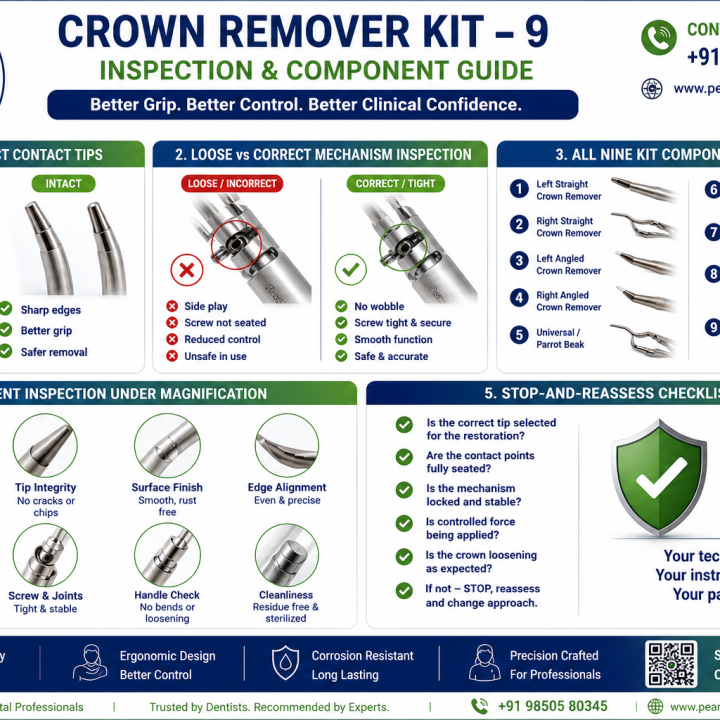
Confirm the selected tip or instrument matches the kit map.
Inspect contact surfaces under strong light.
Check the lock, spring, slide or traction mechanism without applying uncontrolled force.
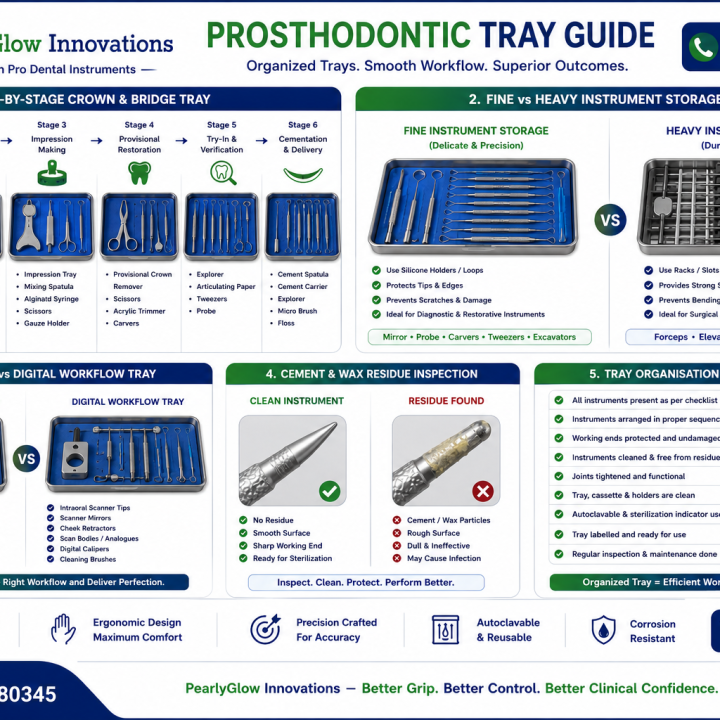
Verify that no cement or debris changes the contact surface.
Confirm the product is not bent, cracked or missing a component.
When to Remove the Instrument from Service
A hook, tip or contact surface is bent or chipped.
The mechanism sticks, releases unexpectedly or feels loose.
Identification is unreadable and the correct component cannot be confirmed.
Corrosion, pitting or rough damage is visible.
The instrument no longer performs according to the approved specification.
Frequently Asked Questions
Should more force be used when the remover slips?
No. Stop and reassess the restoration, purchase point, instrument and method.
Can a worn hook be reshaped chairside?
Unauthorised modification may change the geometry; follow the manufacturer’s assessment process.
Does moisture cause slipping?
Field contamination can affect contact, but it may not be the only cause.
Can one kit tip fit every crown?
No. The contact design and clinical situation vary.
How often should the kit be checked?
After cleaning and before use, with all nine items accounted for.
Need a Crown-Remover Inspection or Replacement?
Message PearlyGlow 919850580345 with: Doctor/Dealer | Kit/Individual Component | Product Photo or Pattern | Quantity | City
WhatsApp 919850580345 PearlyGlow for product identification, catalogue and applicable pricing.