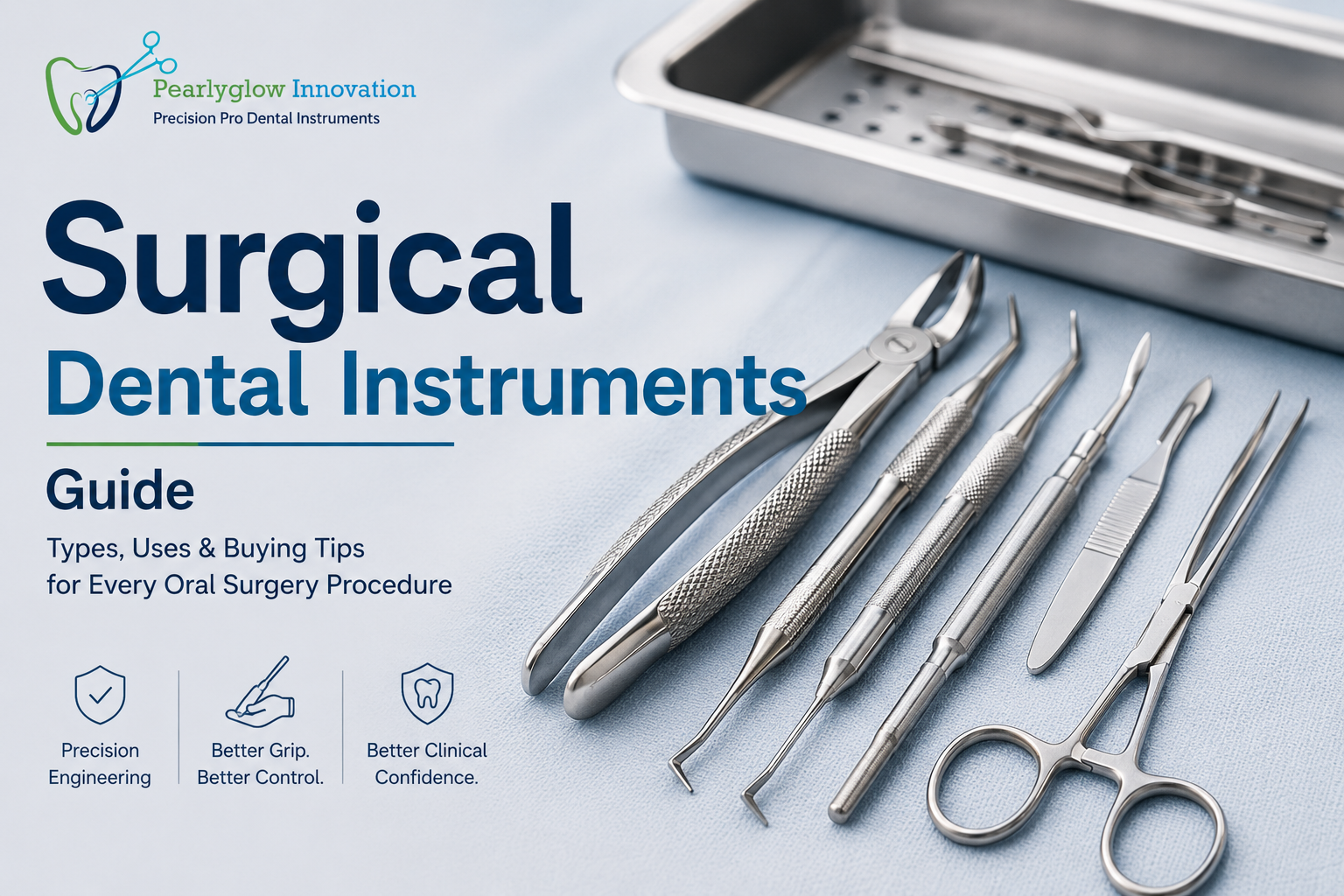
Surgical Dental Instruments Guide: Types, Uses & Buying Tips.
Surgical Dental Instruments Guide
Quick Answer
Surgical dental instruments are specialized tools used during tooth extractions, minor oral surgeries, and other surgical dental procedures. A complete surgical instrument set typically includes extraction forceps, dental elevators, surgical curettes, periosteal elevators, needle holders, and surgical scissors. Choosing well-designed, corrosion-resistant instruments improves precision, safety, and clinical efficiency.
Introduction
Surgical dental instruments are essential for performing safe, controlled, and predictable oral surgical procedures. Whether removing an impacted tooth or managing soft tissue, every instrument contributes to treatment accuracy and patient comfort.
Unlike restorative or diagnostic instruments, dental surgical instruments are designed to withstand higher mechanical forces while providing precise control. Understanding the purpose of each instrument helps dentists build a reliable surgical setup and select equipment suited to their clinical needs (Check more)
Why This Matters for Indian Dentists
Oral surgical procedures are performed daily across private clinics, dental colleges, hospitals, and specialty practices throughout India. From routine extractions to minor surgical interventions, clinicians depend on durable and precisely engineered instruments that perform consistently after repeated sterilization.
Indian practices also experience varying patient volumes and environmental conditions. Instruments manufactured with corrosion-resistant stainless steel and precise working ends generally maintain their performance better over long periods than lower-quality alternatives.
Additionally, clinics performing wisdom tooth surgeries or implant-related procedures often require a broader surgical instrument kit than practices limited to routine extractions.
What Are Surgical Dental Instruments?
Surgical dental instruments are hand instruments designed for procedures involving hard and soft oral tissues. These differ from instruments used during routine examinations (Check more) which are covered in our diagnostic dental instruments guide.They allow clinicians to elevate tissue, loosen teeth, remove bone when required, extract teeth, control bleeding, and close surgical wounds.
A standard oral surgery instrument kit contains several specialized instruments, each designed for a specific stage of treatment.
Surgical Dental Instruments List
1. Surgical Forceps Dental
Extraction forceps securely grasp teeth for controlled removal. Different forceps designs are available for upper and lower teeth as well as anterior, premolar, and molar extractions (Check more).
Well-aligned beaks and balanced handles improve grip while reducing unnecessary force during extraction.
2. Dental Elevators
Dental elevators loosen teeth before extraction by separating the periodontal ligament and gently expanding the socket.
Common root elevators include straight, Cryer, and Warwick James designs, each suited to different extraction techniques.
3. Surgical Curettes
Surgical curettes remove infected tissue, granulation tissue, or residual debris from extraction sockets.
Sharp working ends improve cleaning efficiency while minimizing trauma to surrounding tissues.
4. Periosteal Elevator
A periosteal elevator reflects soft tissue flaps from the underlying bone during surgical procedures.
Proper blade thickness and handle balance allow controlled flap elevation with minimal tissue damage.
5. Bone Rongeurs
Bone rongeurs trim and contour small amounts of bone during oral surgical procedures.
Strong hinge construction ensures smooth cutting performance while maintaining precision.
6. Bone Files
Bone files smooth irregular bony surfaces after trimming.
A well-machined cutting surface helps create even contours before flap closure.
7. Needle Holder Dental
A needle holder dental instrument securely grips suture needles during wound closure.
Proper jaw alignment and locking mechanisms improve suture control throughout the procedure.
8. Surgical Scissors Dental
Surgical scissors dental instruments cut soft tissue, sutures, and surgical materials.
Sharp blades and smooth hinge movement improve accuracy while reducing tissue trauma.
9. Hemostatic Forceps
Hemostatic forceps clamp small blood vessels and control bleeding during surgery.
Reliable locking mechanisms help maintain consistent pressure throughout the procedure.
How to Choose Surgical Dental Instruments
Selecting quality surgical dental instruments involves more than comparing appearance.
Consider the following factors before purchasing:
- Steel Quality – High-grade stainless steel improves corrosion resistance and longevity (Check more).
- Precision Machining – Accurate tips and hinge alignment support predictable clinical performance.
- Grip and Balance – Ergonomic handles reduce operator fatigue during lengthy procedures.
- Joint Performance – Hinged instruments should open and close smoothly without excessive play.
- Sterilization Durability – Instruments should retain their finish and functionality after repeated autoclave cycles.
- Batch Consistency – Every instrument within the same model should perform consistently across purchases.
A dependable surgical dental instruments manufacturer should clearly explain these quality characteristics.
Surgical Instrument Set for Different Practices
Different practices require different surgical instrument combinations.
General Dental Practice
- Extraction forceps
- Dental elevators
- Surgical curettes
- Hemostatic forceps
Oral Surgery Practice
- Complete oral surgery instrument kit
- Bone rongeurs
- Bone files
- Periosteal elevators
- Needle holders
- Surgical scissors
- Advanced extraction forceps
Dental Colleges
Teaching institutions benefit from standardized surgical instrument sets that provide consistent handling characteristics for student training.
Common Mistakes When Buying Dental Surgical Instruments
Many buyers focus only on price.
Instead, evaluate:
- Working-end precision
- Handle ergonomics
- Steel finishing quality
- Joint durability
- Availability of replacement instruments
- Manufacturer support
Choosing instruments solely on initial cost may lead to more frequent replacements and inconsistent clinical performance.
Expert Insight from PearlyGlow Innovations
PearlyGlow Innovations has worked closely with dentists, oral surgeons, hospitals, and dental institutions across India to understand the practical demands of surgical procedures. The company has served more than 5,000 dentists and completed over 200 implementations worldwide, providing valuable feedback on instrument handling, durability, and clinical usability. This experience has reinforced the importance of consistent tip geometry, balanced instrument design, corrosion-resistant finishing, and reliable manufacturing quality. PearlyGlow Innovations focuses on producing surgical instruments that support precision, control, and long-term clinical performance while meeting the routine sterilization requirements of modern dental practices.
Key Takeaways
- Surgical dental instruments support safe and precise oral surgical procedures.
- Every instrument has a specific role within the surgical workflow.
- Steel quality and precision manufacturing directly affect clinical performance.
- Instrument balance improves operator comfort and control.
- Selecting a reliable manufacturer supports long-term consistency.
About PearlyGlow Innovations
PearlyGlow Innovations Pvt. Ltd. manufactures premium dental instruments for clinics, hospitals, dental colleges, and distributors. Guided by the promise of Better Grip. Better Control. Better Clinical Confidence., the company has served over 5,000 dentists and completed 200 implementations worldwide (Check more). For catalogue details or pricing, WhatsApp 98505 80345.
Conclusion
Choosing the right surgical dental instruments improves precision, efficiency, and clinical confidence during oral surgical procedures. Whether selecting extraction forceps, dental elevators, or a complete oral surgery instrument kit, dentists should evaluate steel quality, machining accuracy, ergonomics, and long-term durability. Working with an experienced surgical dental instruments manufacturer helps ensure consistent performance throughout daily clinical practice (Check more).
FAQs
What are surgical dental instruments?
Surgical dental instruments are specialized tools used during tooth extractions, oral surgery, flap procedures, bone management, and suturing.
What instruments are included in a surgical dental instruments list?
A standard surgical dental instruments list includes extraction forceps, dental elevators, surgical curettes, periosteal elevators, bone rongeurs, bone files, needle holders, surgical scissors, and hemostatic forceps.
What are dental elevators used for?
Dental elevators loosen teeth by separating the periodontal ligament before extraction and are also used to remove retained roots.
How do surgical forceps differ from extraction forceps?
Surgical forceps dental instruments are designed for controlled removal of teeth and roots, with different designs available for various tooth types and clinical situations.
Why is stainless steel important in surgical instruments?
High-quality stainless steel improves corrosion resistance, maintains sharpness, and withstands repeated sterilization cycles.
How often should surgical dental instruments be replaced?
Replacement depends on wear, hinge condition, corrosion, and maintenance. Regular inspection helps identify instruments that no longer perform accurately.