
Rhodium Mirror vs Simple Mirror: Which One Should Dentists Choose?
A dental mirror looks like a simple instrument until visibility starts affecting diagnosis, posture, or procedure time.
Dentists use mirrors every day for examination, indirect vision, retraction, illumination, and patient explanation. The quality of the mirror affects how clearly the dentist sees.
That is why the difference between a simple mirror and a rhodium mirror matters.
What Is a Simple Dental Mirror?
A simple dental mirror is commonly used for routine examination and indirect vision.
It supports basic visibility, tissue retraction, and illumination reflection. It is widely used in daily practice and student kits.
A good simple mirror should still provide clear reflection, proper size, handle compatibility, and sterilization durability.
What Is a Rhodium Mirror?
A rhodium mirror is designed to offer improved reflection quality and clearer visibility compared with many standard mirror options.
Rhodium-coated mirrors are often preferred by dentists who want better clarity during detailed procedures.
They can be useful in diagnosis, restorative work, posterior dentistry, endodontic procedures, and clinical photography support.
Where Dentists Notice the Difference
Dentists usually notice the difference during indirect vision.
If the reflection is dull, distorted, scratched, or foggy, the dentist has to adjust posture or pause repeatedly.
A clearer mirror supports better workflow and less visual strain.
Visibility and Clinical Confidence
Better visibility improves clinical confidence.
A mirror should allow the dentist to examine margins, posterior surfaces, restorations, calculus, soft tissue, and preparation areas clearly.
Poor visibility affects both diagnosis and treatment flow.
Durability and Maintenance
Both simple and rhodium mirrors need proper care.
Abrasive cleaning, rough handling, scratches, or poor sterilization practices can reduce mirror quality.
Dentists should train assistants to handle mirrors carefully.
What Dentists Should Check Before Buying
Check reflection clarity
Check mirror size
Check coating quality
Check handle fit
Check anti-fog need
Check scratch resistance
Check sterilization durability
Check replacement ease
Check clinical purpose
Selection Mistakes to Avoid
Buying mirrors only by price
Using scratched mirrors
Ignoring mirror clarity
Using poor-quality handles
Cleaning with abrasive materials
Not replacing damaged mirrors
Using one mirror type for every clinical need
PearlyGlow Clinical Connection
PearlyGlow Innovations Pvt. Ltd. develops, designs, innovates, prototypes, mass-produces, and supplies dental instruments and dental equipment for modern clinical dentistry.
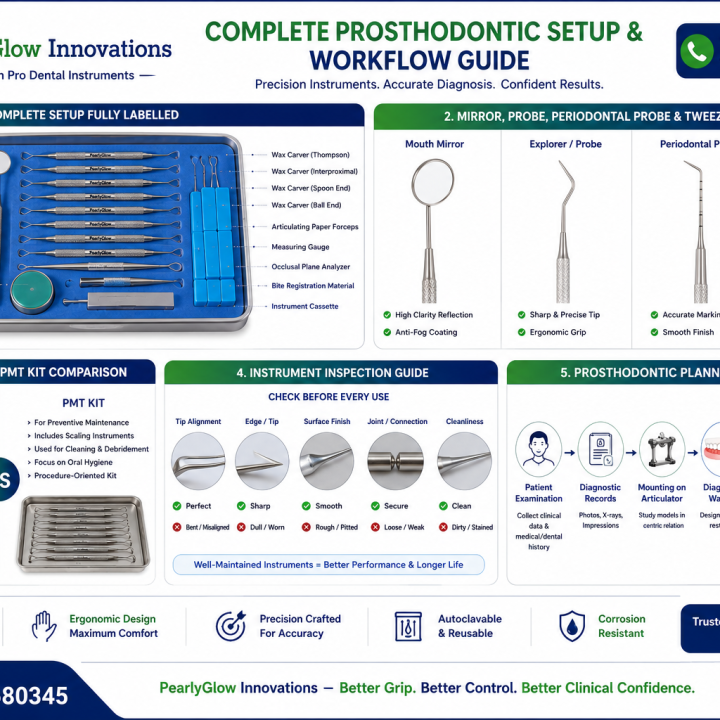
PearlyGlow diagnostic instruments are developed with attention to visibility, grip, surface quality, sterilization durability, and practical daily use.
FAQs
What is the difference between a rhodium mirror and a simple mirror?
A rhodium mirror generally offers better reflection clarity, while a simple mirror is commonly used for routine examination.
Are rhodium mirrors useful in daily practice?
Yes. They can support clearer visibility during detailed clinical work.
Should dental mirrors be autoclavable?
Yes. Dental mirrors and handles should tolerate sterilization when maintained properly.
When should a dental mirror be replaced?
When it becomes scratched, distorted, loose, or difficult to clean.
Which mirror is better for students?
Students may start with simple mirrors, but clearer mirrors can help improve visibility and learning.
Explore PearlyGlow mouth mirrors, rhodium mirrors, and diagnostic instruments for clearer visibility and dependable daily use.
Better visibility supports better clinical decisions.
Better Grip. Better Control. Better Clinical Confidence.