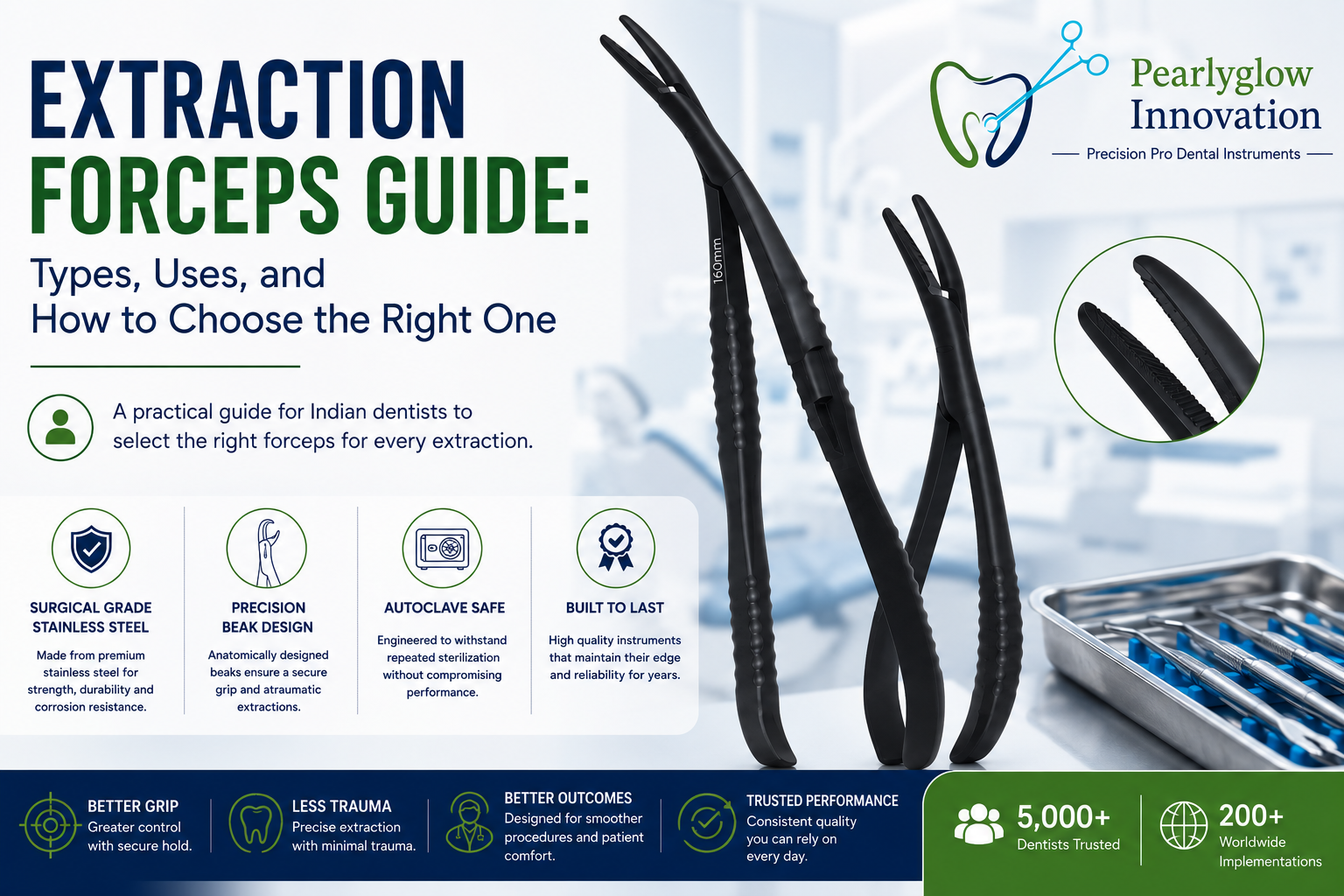
Extraction Forceps Guide: Types & How to Choose | PearlyGlow.
Extraction Forceps Guide: Types, Uses, and How to Choose the Right One
Quick Answer
The right extraction forceps depends on the tooth being extracted, root anatomy, and patient age, not on price or brand alone. A reliable extraction forceps manufacturer offers pattern-specific designs — upper molar, universal, and pediatric — forged from surgical grade extraction forceps steel for a secure, slip-free grip during every procedure.
Choosing the wrong forceps for a molar extraction is one of the fastest ways to turn a routine procedure into a difficult one. Working with the right extraction forceps manufacturer removes that guesswork by matching beak pattern, angle, and grip to the tooth in front of you, rather than forcing one universal design to do every job To understand how forceps fit into a complete clinical instrument setup, read our complete guide to premium dental instruments (Check more).
This guide breaks down the main forceps types used in Indian clinics, what separates a well-made pair from a mediocre one, and how to build a working set that covers your actual case mix.
Why This Matters for Indian Dentists
Most Indian dental colleges teach extraction technique using the English or GDC pattern numbering system, which assigns specific forceps designs to specific tooth groups. A clinician trained this way expects a matching pattern in practice, but many smaller clinics stock only two or three universal-style forceps to save on upfront cost.
This gap between training and actual clinic inventory shows up as longer procedure times and more force applied through an imprecise beak fit. Standardising on a proper forceps range, sized to the patterns taught during BDS and MDS training, closes that gap directly.
For PG students transitioning into independent practice, building this range early avoids relearning technique around whatever forceps happen to be available.
Types of Extraction Forceps and Their Clinical Use
Extraction forceps are not interchangeable. Each pattern is shaped around the anatomy of a specific tooth or tooth group, and using the wrong one increases the force needed and the risk of root fracture.
Upper Molar Extraction Forceps
Upper molar extraction forceps have angled, trifurcated beaks designed to grip the buccal and palatal roots of maxillary molars separately. The left and right patterns differ, since the buccal root anatomy varies by side, so a matched pair is necessary rather than one general design.
Universal Extraction Forceps
Universal extraction forceps are built for general use across multiple tooth positions, typically anterior and premolar teeth with simpler, single-root anatomy. They're a practical starting point for a new clinic, but they should not replace pattern-specific forceps for molars.
Pediatric Extraction Forceps
Pediatric extraction forceps are scaled down in both beak size and handle length to match primary tooth anatomy and a child's smaller oral cavity. Using adult-sized forceps on primary teeth increases the risk of damaging the underlying permanent tooth bud.
Root and Fragment Forceps
Root and fragment forceps have narrower, finer beaks designed to grasp remaining root pieces after a crown fracture during extraction. These are a necessary addition to any kit that regularly handles impacted or brittle teeth.
What to Look For in an Extraction Forceps Manufacturer
A dependable extraction forceps manufacturer should be transparent about three things: the steel specification, the manufacturing process, and pattern availability. Surgical grade extraction forceps are typically made from stainless steel conforming to specifications such as ISO 7153-1, which governs metallic instruments used in surgery and dentistry.
Stainless steel extraction forceps that meet this standard resist pitting and maintain a stable cutting and gripping edge across repeated autoclave cycles. A black extraction forceps coating, where offered, adds a further layer of corrosion resistance suited to India's humid storage conditions, particularly relevant for clinics without climate-controlled sterilisation rooms.
Pattern availability matters just as much as material quality. A manufacturer offering only universal designs cannot support a clinic handling a full range of extractions, regardless of how well those universal forceps are made.
How to Choose the Right Forceps for Your Practice
Start by mapping your actual case mix rather than buying a generic starter set. A general practice doing mostly routine extractions needs a solid universal and upper molar range, while an oral surgery practice needs root forceps and a broader pattern set.
- List the tooth groups you extract most often over a typical month.
- Match each group to its correct pattern, not a universal substitute.
- Check beak fit against a spare tooth or model before purchasing in bulk.
- Confirm the steel grade and autoclave rating in writing.
- Add pediatric or root forceps only once your core adult range is covered.
This approach keeps the buying decision grounded in clinical need rather than catalogue browsing, and it's a more reliable forceps selection guide than price comparison alone.
Expert Insight from PearlyGlow Innovations
PearlyGlow Innovations manufactures its extraction forceps range using forged surgical grade stainless steel, with pattern-specific designs covering upper molar, universal, and pediatric use You can explore PearlyGlow's extraction forceps range to compare available patterns for different clinical applications (Check more). The Black Extraction Forceps in this range uses a rust-resistant coating over a precision-engineered beak, tested for autoclave durability rather than one-time demonstration performance Clinics looking for enhanced corrosion resistance can view the Black Extraction Forceps for detailed specifications (Check here).
Each pattern is designed to match the beak geometry taught in standard Indian dental curricula, so the transition from college training to clinical practice doesn't require relearning technique around mismatched instruments. PearlyGlow Innovations builds its forceps range to be extended gradually, allowing a clinic to add patterns as case complexity grows rather than requiring a full set upfront.
Key Takeaways
- Forceps selection should follow tooth anatomy and pattern, not a single universal design for every case.
- Upper molar forceps require matched left and right patterns due to differing root anatomy.
- Pediatric extraction forceps must be sized separately to avoid damaging developing permanent teeth.
- A dependable extraction forceps manufacturer discloses steel grade, forging process, and pattern range clearly.
- Building a forceps set around your actual case mix outperforms buying a generic bulk kit.
About PearlyGlow Innovations
PearlyGlow Innovations is an Indian dental instruments manufacturer supplying surgical-grade extraction, oral surgery, and restorative instruments to clinics, colleges, and dealer networks. The brand's forceps range is built around one principle: better grip, better control, better clinical confidence. WhatsApp us at 98505 80345 — just send: "Hi PearlyGlow, please send me the forceps catalogue," and we'll respond within 2 hours.
Conclusion
Choosing the right extraction forceps comes down to matching pattern to tooth anatomy and verifying the manufacturing quality behind the instrument, not selecting on price alone. Working with an established extraction forceps manufacturer that discloses steel grade, pattern range, and autoclave rating removes most of the guesswork from this decision, and sets up a clinic's instrument tray to match real clinical demand rather than generic assumptions.
FAQ
What is the difference between universal and pattern-specific forceps?
Universal forceps are designed for general use on simpler, single-root teeth, while pattern-specific forceps like upper molar designs match the exact root anatomy of a tooth group. Using universal forceps on a molar increases the force needed and the risk of root fracture.
Do left and right upper molar forceps really need to be different?
Yes, because the buccal root anatomy of upper molars differs by side, requiring a beak shape matched to that specific root pattern. Using the wrong side's forceps reduces grip precision and can extend procedure time.
Can adult forceps be used safely on children?
No, adult forceps are sized for larger root and crown anatomy and can damage the underlying permanent tooth bud beneath a primary tooth. Pediatric extraction forceps are scaled specifically to avoid this risk.
How do I know if my forceps meet surgical grade standards?
Ask the manufacturer for the specific steel grade and any conformity to recognised specifications such as ISO 7153-1 for surgical dental instruments. A manufacturer unable to confirm this in writing should prompt further questions before purchase.
Are black-coated extraction forceps different from standard stainless steel ones?
Yes, the black coating is a corrosion-resistant surface treatment applied over the base steel, offering extra protection in humid storage conditions. The underlying steel grade and forging process still determine the instrument's core durability.
How many forceps patterns does a general practice actually need?
A general practice typically needs a universal pattern, a matched upper molar pair, and at least one lower molar pattern to cover most routine extractions. Additional patterns can be added as case complexity increases.
Does PearlyGlow Innovations offer forceps for dental colleges and bulk orders?
Yes, PearlyGlow Innovations supplies pattern-specific forceps sets to dental colleges, PG programs, and dealer networks at bulk order tiers. WhatsApp 98505 80345 with your requirement for current availability and pricing.