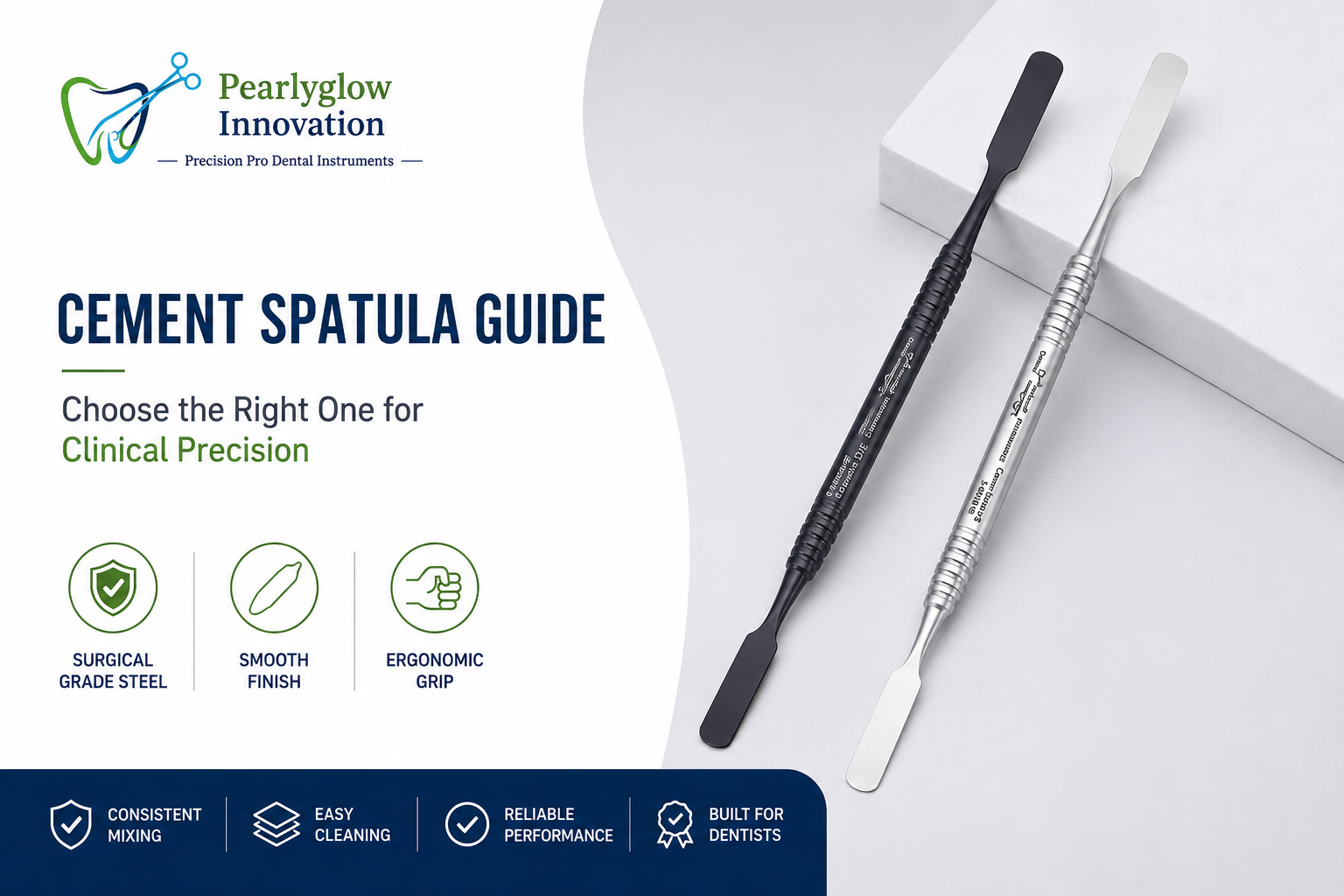
Cement Spatula Guide for Clinical Precision | PearlyGlow.
Cement Spatula Guide: Choosing the Right One for Clinical Precision
Quick Answer
The right cement spatula depends on blade flexibility, blade width, and material compatibility with the luting cement being mixed. A rigid, surgical grade cement spatula gives more consistent mixing for crown and bridge cementation, while a more flexible blade suits softer restorative materials that need gentler manipulation.
A cement spatula seems like the simplest instrument on the tray, until an inconsistent mix compromises a crown cementation you can't easily redo. Choosing the right cement spatula for the material and procedure in front of you affects consistency, working time, and ultimately the bond strength of the finished restoration To learn how restorative instruments fit into a complete clinical setup, read our complete guide to premium dental instruments (Check here).
This guide walks through what actually differs between spatula types, and how to match blade design to your restorative caseload.
Why This Matters for Indian Dentists
Fixed prosthodontics makes up a significant share of restorative work in Indian general practice, with crown and bridge cementation performed routinely across urban and semi-urban clinics alike. A spatula that flexes unpredictably during mixing directly affects cement consistency, which has downstream effects on marginal fit and long-term bond strength.
India's dental material market includes a wide range of luting cements, from traditional glass ionomer to resin-modified and self-adhesive resin cements, each with different mixing requirements. A single generic spatula often can't serve all of these consistently, particularly in clinics handling a high volume of prosthodontic procedures each week.
Standardising on a properly matched spatula for your most-used cement types reduces mixing variability and protects the clinical outcome of every cementation procedure.
What Makes a Cement Spatula "Right" for the Job
Three factors determine whether a cement spatula performs consistently: blade flexibility, blade width, and surface finish. Each affects a different part of the mixing process, and getting one wrong can undermine an otherwise correct cement selection.
Blade Flexibility and Rigidity
A rigid, surgical grade cement spatula gives more controlled, even pressure when mixing thicker luting cements, which helps achieve a uniform consistency without over-thinning the mix. A more flexible dental mixing spatula suits materials that need gentler folding rather than firm pressure, such as some resin-modified formulations.
Blade Width and Shape
Wider blades cover more surface area on a mixing pad, useful for larger batches needed in multi-unit bridge cementation. Narrower blades give more precision for small-batch mixes, common in single-crown cementation where material waste matters more.
Surface Finish and Cement Release
A smooth, well-polished stainless steel cement spatula releases mixed cement cleanly without residue sticking to the blade. A rough or pitted surface holds onto material between uses, which affects both mixing consistency and cleaning time between patients.
Matching Spatula Type to Restorative Procedure
Different cementation procedures benefit from different spatula characteristics, and matching them correctly improves both efficiency and consistency. This isn't about owning every variant, but about understanding which one or two types cover your actual caseload.
- Single crown cementation — a narrower, rigid blade for precise, small-batch mixing.
- Bridge cementation — a wider blade to handle larger volume mixes within working time.
- Glass ionomer cements — a rigid blade that maintains firm folding pressure for proper powder-liquid incorporation.
- Resin-modified cements — a slightly more flexible blade for gentler material manipulation.
- High-volume prosthodontic practices — two spatula types on hand, rather than forcing one design across all cement categories.
Expert Insight from PearlyGlow Innovations
PearlyGlow Innovations manufactures its cement spatula range using surgical grade stainless steel, forged rather than stamped, to maintain consistent blade rigidity across repeated use. The premium cement spatula line includes both standard and wide-blade variants, designed to cover single-unit and multi-unit cementation needs without requiring a separate specialty tool for each case You can explore PearlyGlow's cement spatula range to compare blade sizes and designs for different restorative procedures (Check more).
Each spatula is finished to a smooth, mirror-polished standard that resists cement adhesion during mixing, which reduces cleaning time and residue buildup between procedures. PearlyGlow Innovations tests blade flexibility during manufacturing to keep consistency across a full batch, rather than relying on visual inspection alone.
Key Takeaways
- A cement spatula's blade flexibility should match the luting cement being mixed, not be chosen by handle comfort alone.
- Wider blades suit bridge cementation; narrower blades suit single-crown, small-batch mixing.
- A smooth, well-polished stainless steel cement spatula reduces cement residue and cleaning time.
- High-volume prosthodontic practices benefit from keeping two spatula types on hand rather than one generic design.
- Surgical grade cement spatula construction affects mixing consistency more than price alone.
About PearlyGlow Innovations
PearlyGlow Innovations is an Indian dental instruments manufacturer supplying surgical-grade restorative, extraction, and oral surgery instruments to clinics, colleges, and dealer networks. The brand's cement spatula range is built around one principle: better grip, better control, better clinical confidence. WhatsApp us at 98505 80345 — just send: "Hi PearlyGlow, please send me the cement spatula catalogue," and we'll respond within 2 hours.
Conclusion
Choosing the right cement spatula comes down to matching blade flexibility, width, and finish to the cement type and procedure at hand, rather than defaulting to whichever spatula is already on the tray. A well-matched, surgical grade cement spatula supports more consistent mixing, which directly protects the marginal fit and bond strength of every crown or bridge cementation performed.
FAQ
Does the type of luting cement affect which spatula I should use?
Yes, thicker cements like glass ionomer need a rigid blade for firm mixing pressure, while some resin-modified materials mix better with a slightly more flexible blade. Matching blade rigidity to cement type improves mixing consistency.
Is a wider spatula blade always better for restorative work?
No, wider blades suit larger batches like bridge cementation, but narrower blades give more precision and less material waste for single-crown cases. The right width depends on the batch size, not a universal preference.
How does spatula finish affect cement mixing?
A smooth, well-polished surface releases mixed cement cleanly and resists residue buildup, while a rough or pitted surface holds onto material between uses. This affects both mixing consistency and cleaning time between patients.
Can one cement spatula handle all restorative procedures?
A single spatula can cover basic needs, but high-volume prosthodontic practices benefit from keeping both a rigid and a more flexible variant on hand. This avoids forcing one blade design across cement types it isn't suited for.
What construction should I look for in a surgical grade cement spatula?
Look for forged stainless steel construction with a consistent, mirror-polished finish, since this affects both blade rigidity and cement release during mixing. A supplier should be able to confirm forging process and steel grade in writing.
Does blade flexibility change with repeated sterilisation?
A well-forged spatula should maintain consistent flexibility across repeated autoclave cycles, while a lower-quality blade may develop slight warping over time. Checking blade straightness periodically helps catch this before it affects a mix.
Does PearlyGlow Innovations supply cement spatulas for dental colleges and bulk orders?
Yes, PearlyGlow Innovations supplies standard and wide-blade cement spatula sets to dental colleges, PG programs, and dealer networks. WhatsApp 98505 80345 with your requirement for current availability and pricing.