Signs Your Dental Instruments Need Replacement
Dental Instruments Guide: Signs Your Dental Instruments Need Replacement
Quick Answer
Dental instruments need replacement when they show surface corrosion, blade dulling, hinge play, or beak misalignment, even if they still look functional at a glance. Catching these signs early prevents mid-procedure failure and protects clinical outcomes, since worn instruments often fail gradually rather than all at once.
A forceps that slips slightly, an elevator that feels less sharp than it used to, a hinge with a little more play than last year — none of these feel urgent, until one of them causes a problem mid-procedure. Recognising the early warning signs across your dental instruments before they fail is far easier than reacting after a chairside surprise If you're evaluating overall instrument quality and lifespan, read our complete guide to premium dental instruments (Check more).
This guide walks through the specific wear signs to check for, organised by instrument type, so you can build replacement decisions around evidence rather than guesswork.
Why This Matters for Indian Dentists
India's clinical conditions accelerate certain types of instrument wear more than markets with drier climates or more consistent sterilisation infrastructure. Humidity, variable autoclave maintenance across smaller clinics, and high patient volumes per dentist in urban practices all shorten the realistic lifespan of an instrument that isn't inspected regularly.
The Dental Council of India registers well over 300,000 dentists nationally, and a large share operate in high-volume urban clinics where extraction and surgical instruments see daily, repeated use. In this kind of environment, instrument wear often develops faster than a fixed annual replacement schedule accounts for.
Building routine visual and functional checks into daily practice catches deterioration before it becomes a clinical risk, rather than relying on a calendar-based replacement cycle alone.
General Warning Signs Across All Instrument Types
Some wear signs apply broadly, regardless of whether the instrument is a forceps, elevator, or filling instrument. Checking for these at each sterilisation cycle takes only a few seconds per instrument.
- Surface corrosion or rust spots — any discolouration or pitting on the metal surface, even small spots, signal that the protective finish has broken down.
- Pitting corrosion near hinges or joints — this area holds moisture longer and often shows the earliest signs of surface breakdown.
- Dull cutting edges — an edge that no longer engages material cleanly increases the force needed and the risk of slippage.
- Loose hinge or loose joint movement — excess play in a hinged instrument affects control and precision during use.
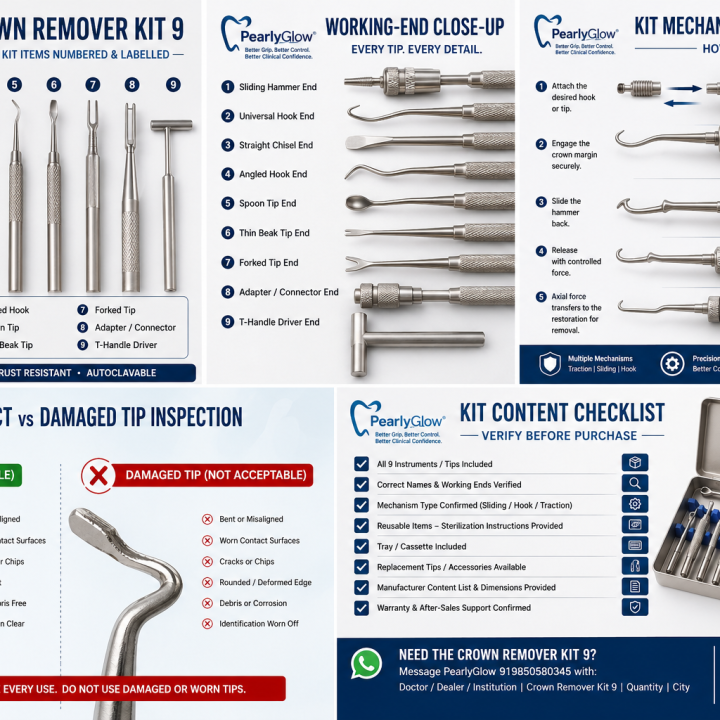
- Bent or chipped instrument tips — any visible deformation at the working end compromises fit and function immediately.
Instrument-Specific Signs to Watch For
General wear signs are a useful starting point, but each instrument category also has specific failure patterns worth checking individually.
Extraction Forceps
Check that the beak closes flush with no visible gap at the tip, since even a small gap increases the risk of slippage during extraction. A grip surface that has become smooth or slick, particularly on a knurled handle, is another sign the forceps is approaching the end of its usable life You can also browse PearlyGlow's extraction forceps range to compare forged surgical-grade options (Check more).
Dental Elevators and Luxators
Elevators should be checked for blade tip sharpness and shank rigidity, since a flexing shank transmits less force where it's needed. Luxators need particular attention to their thin cutting edge, which dulls faster than a wider elevator blade due to its finer geometry t o see instruments designed for long-term durability, explore dental elevators and luxators (Check here)
Composite Filling Instruments
Composite filling instrument tips should be checked for a smooth, even surface free of pitting, since a rough tip causes material to stick and accumulate during use. Any visible bending in a condenser or carver tip affects the accuracy of the restoration being shaped.
Metal Fatigue and Instrument Fatigue: What's Happening Beneath the Surface
Instrument fatigue develops gradually through repeated stress cycles, even when an instrument shows no visible surface damage. Every time a forceps or elevator is used under load and then sterilised at high heat, microscopic stress accumulates within the metal's internal structure.
This is why an instrument that looks unchanged externally can still fail unexpectedly, particularly at a hinge pin or a beak's thinnest point. Forged instruments generally resist this kind of fatigue better than cast ones, since their denser grain structure distributes stress more evenly.
A practical way to catch fatigue before failure is to periodically test hinge tension and flex resistance by hand, comparing older instruments against a known-good newer one from the same set.
Expert Insight from PearlyGlow Innovations
PearlyGlow Innovations designs its instrument ranges around forged surgical grade stainless steel specifically because forged construction resists metal fatigue better than cast alternatives across repeated clinical use. The brand recommends visual inspection at every sterilisation cycle rather than a fixed replacement calendar, since actual wear depends heavily on procedure volume and handling conditions.
For clinics unsure whether an instrument has reached the end of its usable life, PearlyGlow Innovations' team can review photographs of wear signs and advise whether replacement or continued use is appropriate. This approach reflects a simple principle: replacement decisions should follow evidence of wear, not an assumed timeline.
Key Takeaways
- Surface corrosion, hinge play, and dulled edges are the clearest early signs a dental instrument needs replacement.
- Extraction forceps should close flush at the beak tip; any visible gap increases slippage risk.
- Luxators dull faster than elevators due to their thinner cutting edge, and need more frequent checking.
- Instrument fatigue can develop internally without visible surface damage, particularly in cast instruments.
- Visual inspection at every sterilisation cycle catches wear earlier than a fixed annual replacement schedule.
About PearlyGlow Innovations
PearlyGlow Innovations is an Indian dental instruments manufacturer supplying surgical-grade extraction, oral surgery, and restorative instruments to clinics, colleges, and dealer networks. The brand designs its instruments around forged construction specifically to resist the fatigue and corrosion patterns common in Indian clinical conditions. WhatsApp us at 98505 80345 — just send: "Hi PearlyGlow, please send me the replacement guide," and we'll respond within 2 hours.
Conclusion
Recognising the early signs of wear across your dental instruments — corrosion, dulling, hinge play, and tip damage — protects both procedure quality and patient safety far more reliably than waiting for an obvious failure. A short, routine inspection at each sterilisation cycle is a small habit that prevents a much larger disruption during an actual procedure.
FAQ
How often should dental instruments be checked for wear?
Dental instruments should be visually checked at every sterilisation cycle, not on a fixed annual schedule, since actual wear depends on procedure volume and handling. Catching early signs during routine checks prevents failure during an actual procedure.
What does pitting corrosion look like on a dental instrument?
Pitting corrosion appears as small, localised dark spots or rough patches on the metal surface, often starting near hinges or joints where moisture lingers longest. Any visible pitting signals the protective surface has already broken down.
Can a dental instrument fail without visible surface damage?
Yes, metal fatigue can accumulate internally from repeated stress and sterilisation cycles without producing obvious external signs. This is more common in cast instruments than forged ones, since forged steel resists internal stress better.
Is a loose hinge always a sign of replacement, or can it be repaired?
A loose hinge often indicates internal wear at the pin or joint that typically cannot be reliably repaired to original tolerance. In most cases, replacement is safer than attempting a repair on a surgical instrument.
Do luxators wear out faster than elevators?
Yes, luxators generally dull faster than elevators because their thinner cutting edge experiences more concentrated stress during ligament severing. Checking luxator edge sharpness more frequently helps catch this earlier.
Should composite filling instruments be checked differently from extraction instruments?
Yes, composite filling instruments should be checked for tip smoothness and material accumulation, while extraction instruments are checked more for beak alignment and grip. Each instrument type has a different primary failure pattern to watch for.
Does PearlyGlow Innovations help clinics assess whether an instrument needs replacing?
Yes, PearlyGlow Innovations' team can review photographs of wear signs and advise on replacement versus continued use. WhatsApp 98505 80345 with your query for guidance and current catalogue availability.