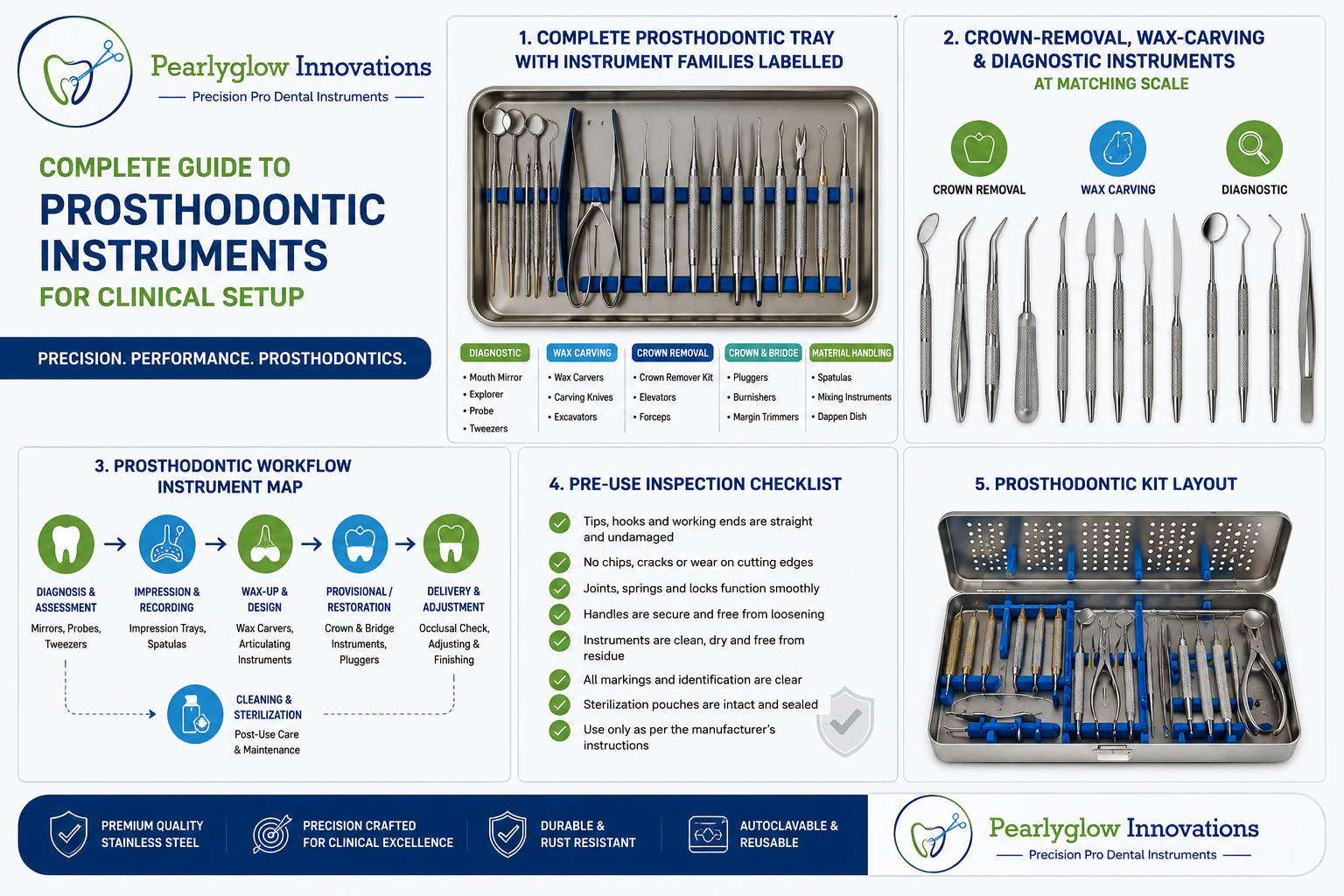
Complete Guide to Prosthodontic Instruments for Clinical Setup.
Quick Answer
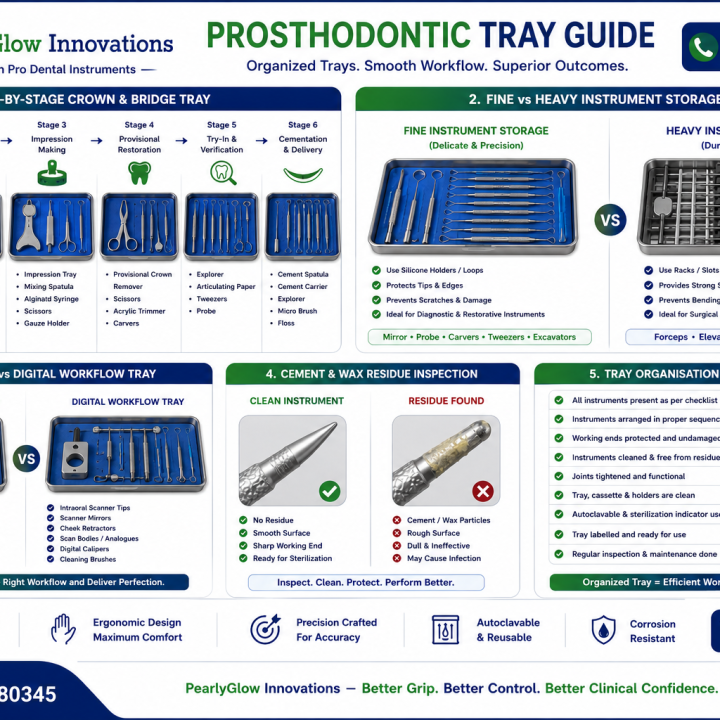
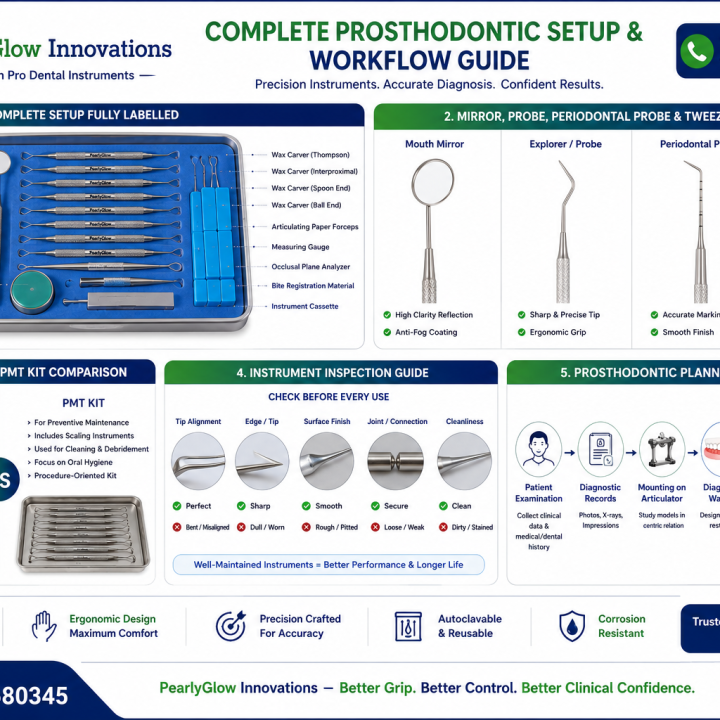
A prosthodontic instrument setup may include diagnostic instruments, impression and material-handling instruments, wax-carving instruments, crown and bridge adjustment or removal instruments, tweezers, occlusal-marking accessories and procedure-specific kits. The correct setup depends on whether the work involves diagnosis, treatment planning, fixed prosthodontics, removable prosthodontics, implant prosthodontics, provisionalisation, laboratory wax-up or restoration removal. Instrument selection should follow the clinician’s protocol and the exact verified product design.
The American College of Prosthodontists describes prosthodontic care as a structured process that may include diagnostic casts or digital articulation, diagnostic wax-up or virtual design and treatment-specific procedures. This means the instrument tray should support the clinical stage rather than simply contain a large number of tools. [1]
Core Instrument Families
Diagnostic instruments
Mirrors, probes, tweezers and occlusal-assessment accessories support examination, visibility, margin assessment and material transfer.
Wax carvers
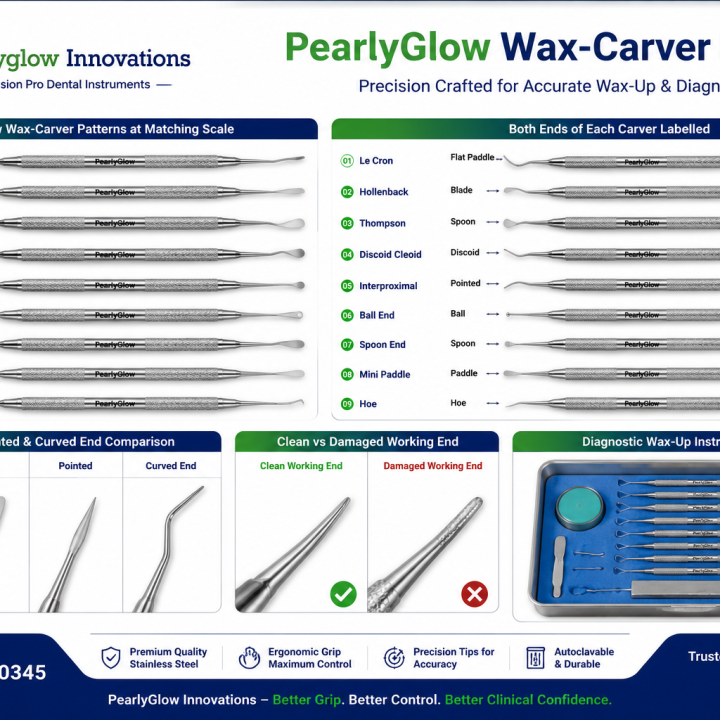
Wax carvers use pattern-specific blades or points for diagnostic wax-up, contouring and selected laboratory or provisional-material workflows.
Crown-removal instruments
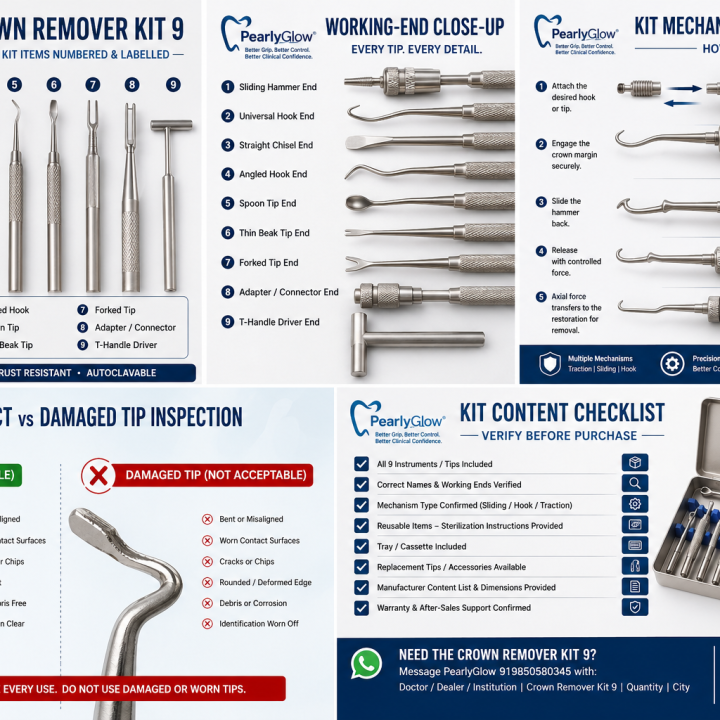
Crown removers and related instruments are selected according to the restoration, cement, access, preservation objective and clinician technique. No one method is suitable for every restoration. [2,3]
Crown and bridge supporting instruments
Tweezers, spatulas, carvers, burnishers and diagnostic tools may support provisional, cementation, adjustment and assessment workflows.
Prosthodontic kits
A kit should combine only the instruments required for the intended clinic, department or curriculum, with every item clearly identified.
Selection Table
Instrument family | Main selection focus | What must be verified |
|---|---|---|
Diagnostic setup | Visibility, assessment and material transfer | Exact mirror, probe, tweezer and supporting contents |
Wax carver | Blade/point shape, angulation and material workflow | Pattern name, working ends, dimensions and approved use |
Crown remover | Restoration-removal approach and access | Kit contents, tip patterns, mechanism and limitations |
Crown/bridge support instruments | Material handling, contouring and occlusal assessment | Exact working ends and procedure stage |
Prosthodontic kit | Buyer need and complete coverage | Every included item, image, availability and replacement options |
What to Inspect Before Use
Crown-remover tips, hooks or contact surfaces are not bent, chipped, loose or worn.
Wax-carver blades and points retain their original shape and are free from rough damage.
Diagnostic mirrors, probes and tweezers remain clear, aligned and correctly identified.
Locks, springs, joints or sliding mechanisms operate smoothly where present.
Every reusable instrument has been cleaned, inspected, packaged and processed according to the approved instructions.
Cleaning and Reprocessing
Reusable prosthodontic instruments should be cleaned before sterilisation so that residual cement, wax, impression material, blood or debris does not interfere with inspection and processing. CDC guidance recommends trained personnel, validated manufacturer instructions, inspection after cleaning and heat sterilisation of heat-tolerant semicritical instruments. [5,6] Exact chemicals, cycle parameters and finish compatibility must come from PearlyGlow’s approved instructions.
PearlyGlow Prosthodontic Range
PearlyGlow’s current content and product-planning records identify Crown Remover Kit 9, Wax Carvers and a Prosthodontic Diagnostic Setup as required prosthodontic products. A separate working product file also contains a Prosthetic Kit entry. Exact contents, active status, product names, materials, finishes and URLs must be reconciled before publication.
PearlyGlow is guided by its founder, who brings more than 26 years of experience in engineering, product design, development and manufacturing, including involvement in more than 200 global design and development projects.
Frequently Asked Questions
What instruments belong in a prosthodontic setup?
The set may include diagnostic instruments, wax carvers, crown and bridge instruments, tweezers, material-handling tools and procedure-specific kits.
Is a crown-remover kit suitable for every crown?
No. Restoration type, cement, access and the preservation objective affect method selection.
Why are wax carvers available in different patterns?
Working-end shape and angulation change access and contouring behaviour.
Can a general diagnostic kit be used for prosthodontics?
It may support basic examination, but a prosthodontic setup may require additional occlusal, material-handling and crown/bridge instruments.
How should a clinic choose a kit?
Review the exact procedure mix, existing instruments, included patterns, replacement availability and approved care instructions.
Need Help Building a Prosthodontic Instrument Set?
Message PearlyGlow 919850580345 with: Doctor/Dealer/Student/Institution | Required Instruments or Kit | Quantity | City
WhatsApp 919850580345 PearlyGlow for verified product selection, catalogue and applicable pricing.