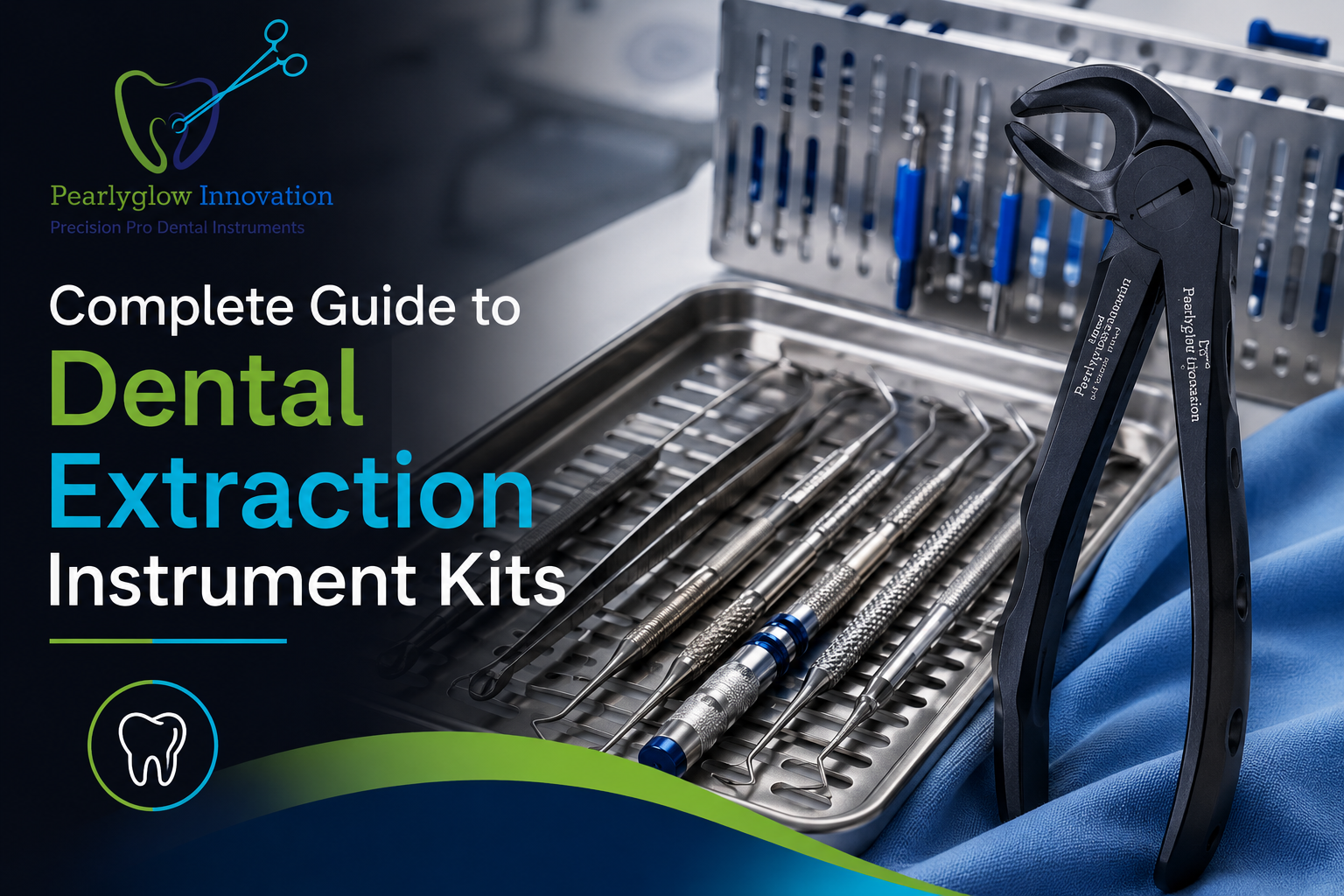
Complete Guide to Dental Extraction Instrument Kits
Complete Guide to Dental Extraction Instrument Kits
Quick Answer
A complete dental extraction instrument kit includes pattern-specific forceps, straight and angled elevators, luxators, and at least one root fragment instrument, covering routine and surgical extraction cases. Coverage should match a clinic's actual case mix rather than following a fixed generic list, since a general practice and an oral surgery practice need different kit compositions.
Assembling an extraction kit by picking whatever's available at a supplier, rather than working from a clinical checklist, is how clinics end up mid-procedure without the right instrument. A properly built dental extraction instrument kit covers routine single-root extractions through to impacted tooth cases, without gaps that force improvisation at the chair.
This guide walks through what a complete kit should contain, how the pieces work together, and how to size a kit to your actual practice (Check more).
Why This Matters for Indian Dentists
Indian dental colleges teach a structured, pattern-based approach to extraction instruments, covering specific forceps and elevator designs by tooth group and procedure type. Many general practices, however, work from a smaller, ad hoc collection built up over years rather than a deliberately assembled kit, which leaves gaps that only become obvious during a difficult case.
India's dentist-to-population ratio sits well ahead of the WHO's minimum access benchmark nationally, but that average conceals heavy urban concentration, with a large majority of dentists practising in cities and managing correspondingly higher patient volumes. In that kind of high-turnover practice, an incomplete kit doesn't just slow down a single procedure — it compounds across every extraction day performed.
Building a complete kit once, matched to real case volume, is more efficient than repeatedly sourcing individual instruments reactively as gaps appear.
What a Complete Extraction Kit Should Include
A properly assembled kit covers three functional stages of extraction: loosening the tooth, lifting it from the socket, and managing any remaining fragments. Each stage needs its own dedicated instruments rather than one tool trying to serve multiple purposes.
Extraction Forceps
A dental extraction forceps kit should include a universal pattern for anterior and premolar teeth, plus matched left and right upper molar forceps, since maxillary root anatomy differs by side. Lower molar and root-specific patterns round out coverage for a general practice's routine caseload (Check more).
Dental Elevators
Straight elevators, such as the Coupland pattern, handle general-purpose leverage against bone across most tooth positions. Angled elevator patterns provide access in tighter spaces where a straight blade can't be positioned effectively.
Luxators
Luxators sever periodontal ligament attachment before elevation begins, reducing the force needed during the lifting stage that follows. A kit should include at least a standard straight luxator, with curved variants added for practices handling more surgical cases (Check more).
Surgical Elevators for Impacted Cases
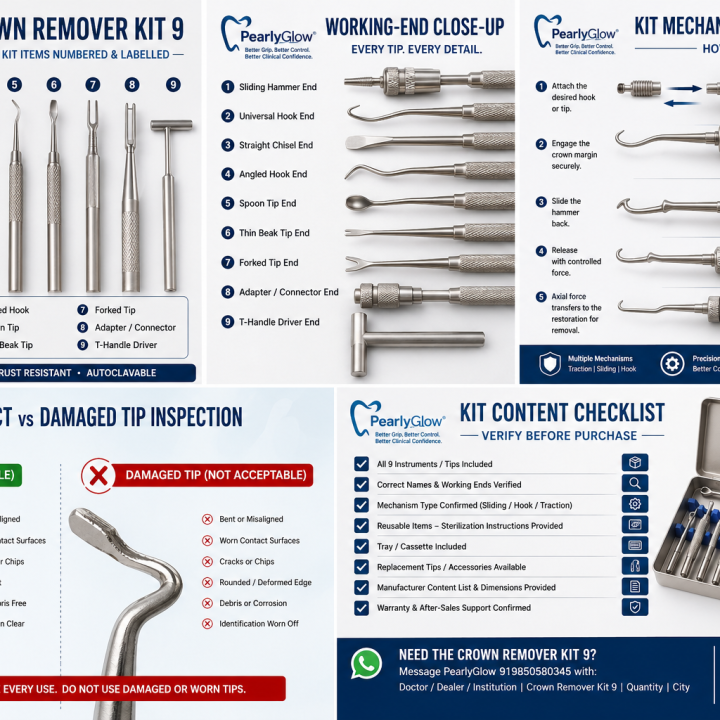
Warwick James elevators, with their narrower, angled tips, are designed for working in the limited access common to impacted and third molar extraction. Cryer elevators, with their triangular cross-section, are built specifically for root fragment removal after a crown fracture during extraction (Check here).
Building a Kit for Routine vs Surgical Practice
A general practice and an oral surgery practice need meaningfully different kit compositions, even though both fall under the same "extraction kit" category. Matching the kit to actual case type avoids both under-equipping and unnecessary spend on rarely-used instruments.
- General practice, routine extractions — universal forceps, upper molar pair, straight elevators, one standard luxator.
- General practice with occasional surgical cases — add angled elevators and a curved luxator to the routine set.
- Oral surgery or high-volume impacted case practice — add Warwick James elevators, Cryer elevators, and root fragment forceps.
- Dental colleges and PG training programs — a broader pattern range to expose students to the full technique set taught in curriculum.
- New clinics starting out — begin with the routine set, then expand toward surgical coverage as case complexity grows.
Kit Maintenance and Longevity Considerations
A dental surgery instrument kit is only as reliable as its weakest component, so maintenance habits matter as much as initial instrument quality. Rinse instruments promptly after use, clean via ultrasonic bath before autoclaving, and dry fully to protect corrosion resistance across the kit's working life.
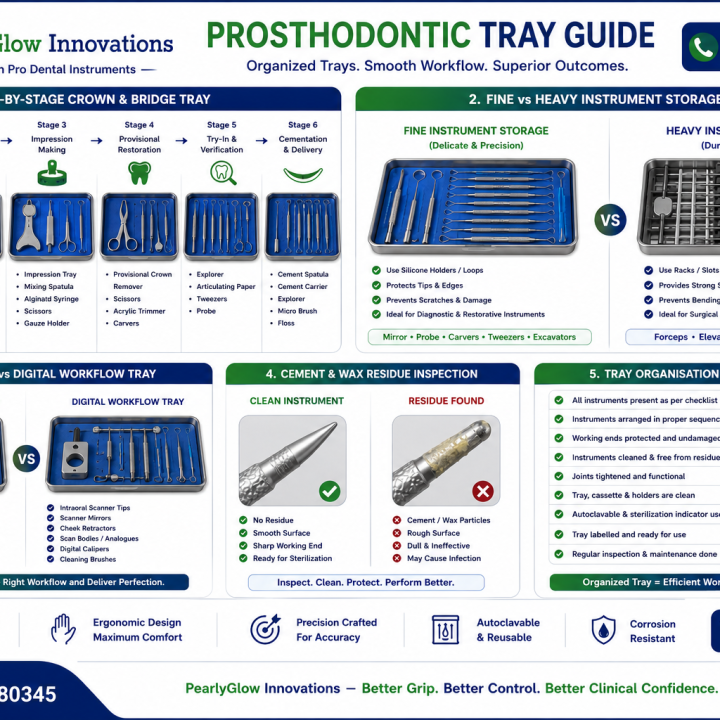
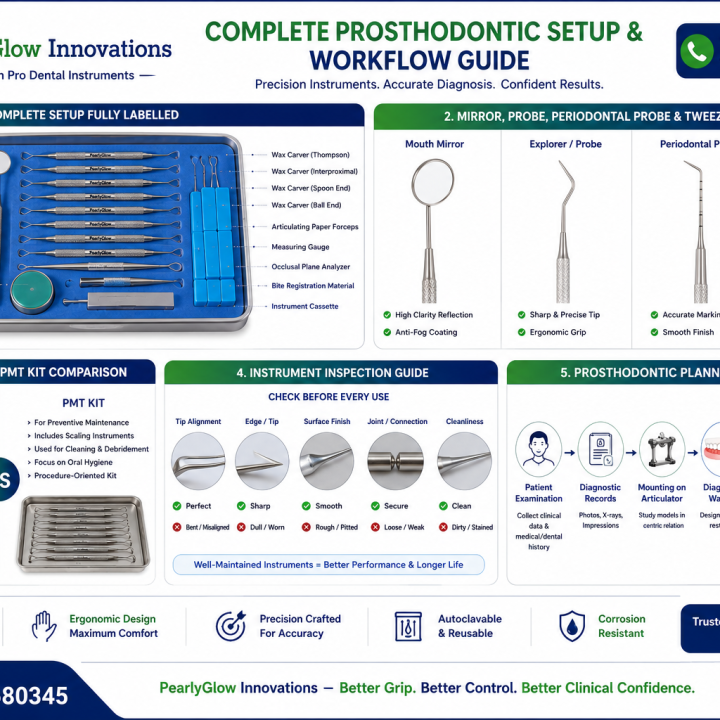
Store each instrument in a labelled tray position rather than loose, so gaps in the kit are immediately visible before a procedure begins rather than discovered mid-case. Periodic visual inspection for beak alignment, hinge play, and edge dulling catches wear before it compromises atraumatic extraction technique.
Expert Insight from PearlyGlow Innovations
PearlyGlow Innovations manufactures extraction kits covering forceps, elevators, and luxators using forged surgical-grade stainless steel, with pattern options spanning routine and surgical extraction needs. The premium dental extraction kit range is built to match the pattern designs taught in standard Indian dental curricula, so clinicians don't need to adapt technique around mismatched instruments (Check here).
Kits can be built incrementally, starting with a routine set and adding surgical elevators or root fragment instruments as a practice's case complexity grows. Every instrument in the range is tested for autoclave durability before its cycle rating is published, rather than assumed from steel specification alone.
Key Takeaways
- A complete dental extraction instrument kit covers three stages: luxation, elevation, and fragment management.
- Warwick James and Cryer elevators are specifically suited to impacted tooth extraction and root fragment removal.
- General and surgical practices need different kit compositions, not one universal set for every clinic type.
- Kit maintenance — rinsing, ultrasonic cleaning, and labelled storage — protects the full set's working life.
- Build a kit incrementally, starting with routine coverage and expanding toward surgical instruments as needed.
About PearlyGlow Innovations
PearlyGlow Innovations is an Indian dental instruments manufacturer supplying surgical-grade extraction kits, oral surgery instruments, and restorative tools to clinics, colleges, and dealer networks. The brand's extraction range is built around one principle: better grip, better control, better clinical confidence. Ready to build your kit? WhatsApp us at 98505 80345 — just send: "Hi PearlyGlow, please send me the extraction kit catalogue," and we'll respond within 2 hours.
Conclusion
A well-assembled dental extraction instrument kit covers routine and surgical needs without gaps, built around a clinic's actual case mix rather than a generic supplier list. Prioritising pattern-specific coverage, verified steel and forging quality, and consistent maintenance gives a practice a kit that performs reliably from routine extractions through impacted tooth cases.
FAQ
What is the minimum kit a new dental clinic should start with?
A new clinic should start with universal forceps, a matched upper molar pair, straight elevators, and a standard luxator, covering most routine extractions. Surgical instruments like Warwick James or Cryer elevators can be added as case complexity increases.
What is the difference between Coupland and Warwick James elevators?
Coupland elevators are straight, general-purpose instruments used for leverage across most tooth positions, while Warwick James elevators have narrower, angled tips designed for limited-access impacted tooth extraction. Each serves a different access scenario.
Are Cryer elevators necessary for a general dental practice?
Cryer elevators are primarily used for root fragment removal after a crown fracture, so they're most valuable for practices handling surgical or complex extractions regularly. A general practice with mostly routine cases may only need occasional access to this pattern.
How many luxators does a typical extraction kit need?
A typical kit needs at least one standard straight luxator for routine ligament severing, with curved variants added for practices handling more surgical extraction cases. Coverage should match actual procedure complexity, not a fixed number.
Does a surgical extraction kit need different forceps from a routine kit?
Yes, surgical kits often add root and fragment forceps alongside standard patterns, since impacted and complicated extractions more frequently involve residual root pieces. Routine kits can typically function with a smaller forceps range.
How should an extraction kit be maintained between procedures?
Rinse instruments promptly after use, clean via ultrasonic bath before autoclaving, and store each piece in a labelled tray position to catch gaps and wear early. This routine protects both instrument longevity and procedure readiness.
Does PearlyGlow Innovations supply complete extraction kits for dental colleges?
Yes, PearlyGlow Innovations supplies routine and surgical extraction kits to dental colleges, PG programs, and dealer networks at bulk order tiers. WhatsApp 98505 80345 with your requirement for current availability and pricing.